

Content Clusters: How to Build Topical Authority That Ranks
Learn exactly how to structure pillar pages and cluster content to dominate entire topic categories in your niche — and signal deep expertise to Google at scale.
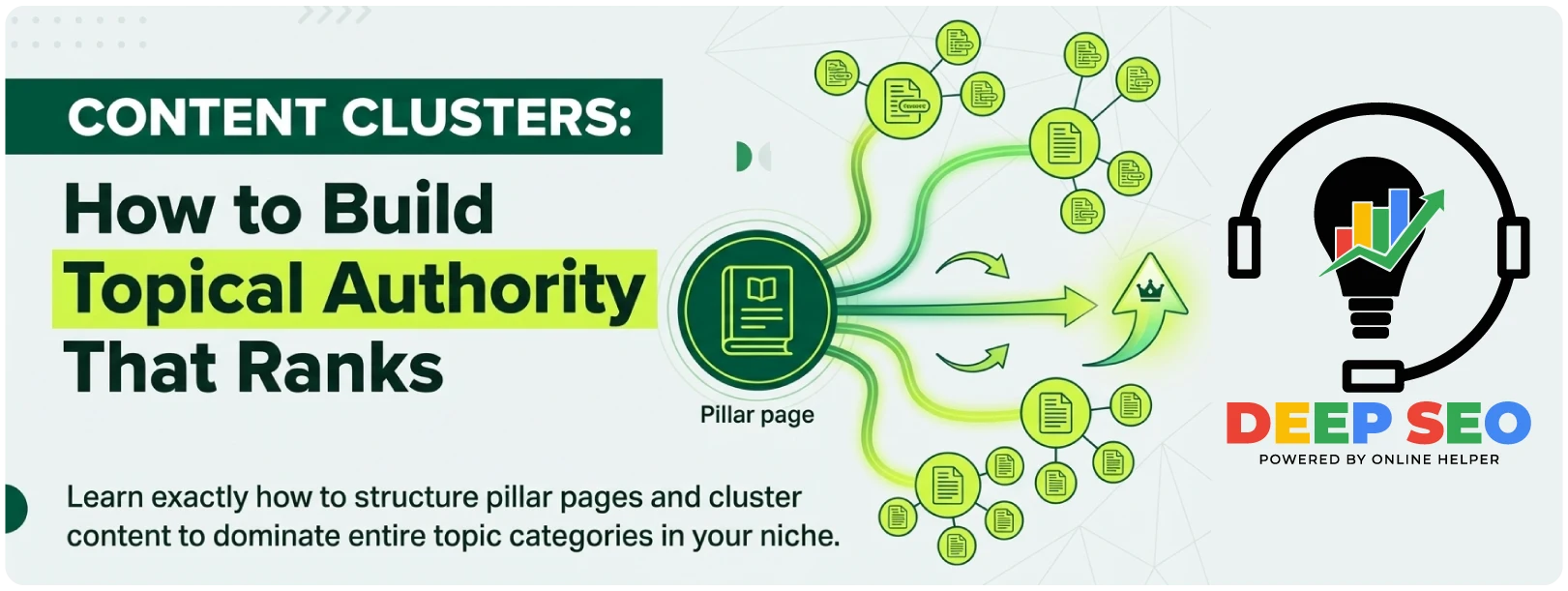
Google no longer ranks individual pages in isolation — it ranks websites that demonstrate deep, comprehensive knowledge about a subject. Content clusters are the most reliable way to build that authority. Here’s how to do it from scratch.
What Is Topical Authority?
Topical authority means Google trusts your website as a reliable, comprehensive source on a specific subject. Instead of ranking for scattered keywords, you build a connected web of content that covers a topic from every angle — making your site the go-to resource in your niche.
The shift toward topical authority accelerated with Google’s Helpful Content updates. Sites with shallow, disconnected content saw ranking drops. Sites with deep, interlinked topic coverage saw significant gains.
You don’t need to cover every topic on the internet. Pick 3–5 core topics relevant to your business and build clusters around those first. Depth beats breadth every time.
Pillar Page vs Cluster Page: The Difference
A pillar page is a long-form, comprehensive guide on a broad topic (e.g., “The Complete Guide to SEO”). It covers the topic at a high level and links to cluster pages for deeper coverage. A cluster page covers a specific subtopic in depth (e.g., “How to Do Keyword Research”) and links back to the pillar. Together, they form a hub-and-spoke content model that distributes link equity and signals expertise.
The 6-Step Framework
Choose Your Core Topics
Identify 3–5 broad topics that sit at the intersection of your expertise and your audience’s needs. Each topic should have enough subtopics to support 8–15 cluster pages. Use keyword research tools to validate search demand exists.
Map Keywords to Each Topic
Export all keyword ideas for your core topic and group them by subtopic. Each unique subtopic becomes a cluster page. Look for keyword groups with clear informational, commercial, or transactional intent — this determines content format.
Build Your Pillar Page
Write a comprehensive 3,000–5,000 word guide covering your core topic. Use clear H2/H3 structure. Don’t go too deep on any one section — instead link out to cluster pages. The pillar’s job is breadth, not depth. Optimise it for the highest-volume head term.
Create Cluster Content
Write dedicated pages for each subtopic in your cluster. Each page should be 1,200–2,500 words, cover the subtopic exhaustively, and answer the specific search intent for that keyword group. Include original insights, examples, and data where possible.
Execute Internal Linking
Every cluster page must link back to the pillar using keyword-rich anchor text. The pillar must link out to every cluster page. Add contextual links between related cluster pages too — this creates a content web, not just a hub-and-spoke.
Measure Authority Growth and Expand
Track impressions, rankings, and clicks for each cluster over 60–90 days. When a cluster begins ranking, identify gaps — subtopics you haven’t covered yet — and add new cluster pages. Topical authority compounds: the more you cover, the more Google trusts you.
Common Mistakes to Avoid
The most frequent mistakes are: publishing cluster pages without linking them to a pillar, writing cluster content that overlaps and cannibalises each other, and building clusters on topics too broad to win authority on. Keep each cluster tightly focused on a single core topic your site can realistically dominate.
Ready to build a content cluster strategy for your site? Get a free SEO audit and we’ll map out your first cluster framework in the consultation.
Found this useful? Share it.
More SEO Insights

10 Proven SEO Strategies to Dominate Google in 2026
A step-by-step walkthrough of the exact audit process we run for every new client.

How to Find SEO Quick Wins in Google Search Console
Learn how to structure pillar pages and cluster content to dominate entire topic categories.

How to Conduct a Full Technical SEO in 2026
The exact GSC filters we use to find pages one optimisation away from a major rankings jump.
